
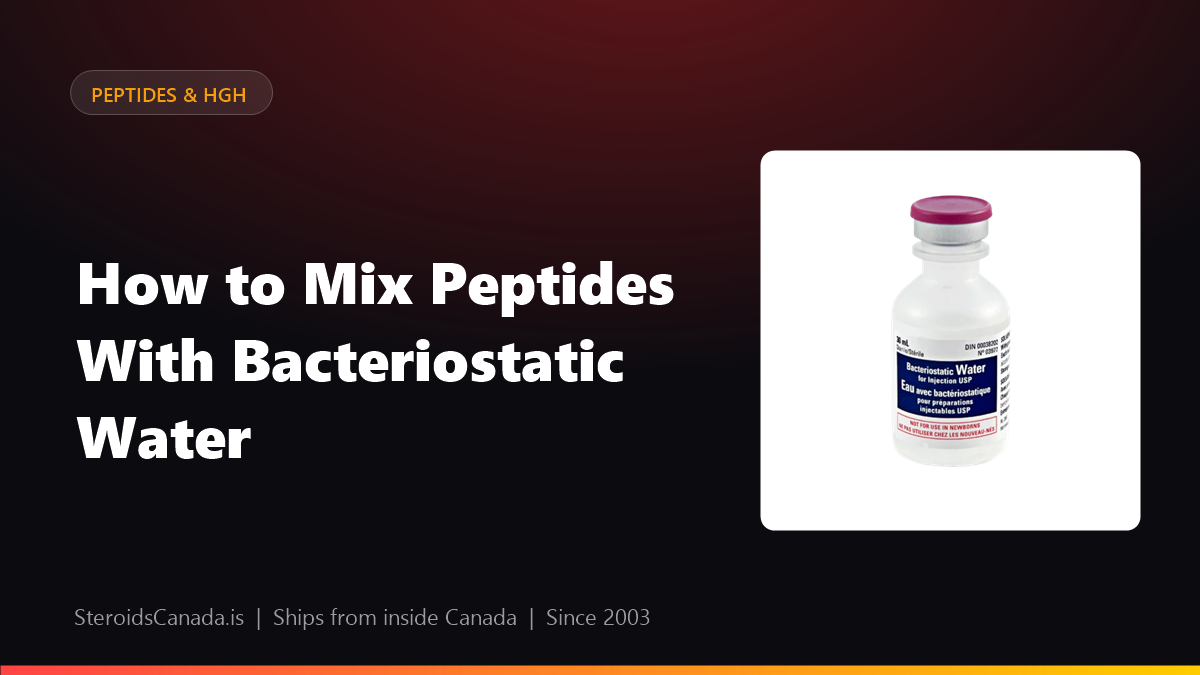
- Bacteriostatic water contains a little benzyl alcohol, which stops bacteria growing in a vial you use more than once.
- Add water slowly down the side of the vial and swirl gently; never shake.
- The amount of water only changes concentration, not the total peptide; pick an amount that makes measuring easy.
- Refrigerate after mixing and use within the time recommended for that peptide.
Most peptides arrive as a freeze-dried powder that has to be mixed (reconstituted) before use. Getting this right matters for accuracy and safety. This guide walks through the steps and the maths.
Bacteriostatic vs sterile water
- Bacteriostatic water: sterile water with 0.9% benzyl alcohol. Suitable for multi-use vials.
- Sterile water: no preservative. Best for single use; bacteria can grow once punctured.
Bacteriostatic water is sold separately; it isn’t included with peptide vials.
What you need
- The peptide vial and bacteriostatic water
- A syringe to add water (1 ml or 3 ml)
- U-100 insulin syringes for injecting
- Alcohol swabs and a sharps container
Step by step
- Wash your hands and work on a clean surface
- Let vials reach room temperature
- Swab both rubber stoppers and let them dry
- Draw the chosen amount of bacteriostatic water
- Insert the needle into the peptide vial and let the water run slowly down the glass wall, not directly onto the powder
- Swirl gently or roll between your palms until dissolved; don’t shake
- Check the solution is clear; don’t use it if cloudy or containing particles
- Label the vial with the date and concentration, then refrigerate
The maths
A U-100 insulin syringe holds 1 ml in 100 units, so each unit is 0.01 ml.
| Vial | Water added | Concentration | 250 mcg equals |
|---|---|---|---|
| 5 mg | 1 ml | 5,000 mcg/ml | 5 units |
| 5 mg | 2 ml | 2,500 mcg/ml | 10 units |
| 10 mg | 2 ml | 5,000 mcg/ml | 5 units |
| 10 mg | 3 ml | 3,333 mcg/ml | 7.5 units |
More water makes small amounts easier to measure accurately. Our peptides page has a mixing calculator that does this for any vial.
The calculator only does the maths. It doesn’t recommend an amount; talk to a doctor about dosing.
Storage
- Unmixed: cool, dark place or fridge, per the peptide
- Mixed: refrigerate at 2 to 8 °C; don’t freeze
- Many mixed peptides are commonly used within about four weeks; follow guidance for the specific peptide
Sterile technique
Use a new syringe for every injection, swab the stopper each time, and never share vials or needles. See our injection guide and peptides introduction.
Frequently asked questions
How much bacteriostatic water should I add?
Commonly 1 to 3 ml. The amount sets concentration; choose one that makes your measurements easy.
Can I use sterile water instead?
For single use, yes. For a vial used over days, bacteriostatic water is safer.
Should I shake the vial?
No. Swirl or roll gently; shaking can damage peptides.
How many units is 250 mcg?
It depends on concentration. With 5 mg in 2 ml, 250 mcg is 10 units on a U-100 syringe.
Products mentioned in this guide

This article is general information for adults in Canada, not medical advice. Talk to a doctor or pharmacist before using any prescription drug, anabolic steroid or research compound, and get bloodwork done. If you’re in crisis, call or text 9-8-8 (Suicide Crisis Helpline) any time.




Add comment
You must be logged in to post a comment.