

Understanding What Actually Changes When You Go from Bulking to Cutting
The shift from bulking to cutting is one of the most misunderstood phases in physique training. During a bulk, your entire nutritional strategy is built around eating more calories than your body burns each day. That surplus, combined with consistent resistance training, creates the environment your muscles need to grow. Carbohydrate intake tends to be high, overall food volume is generous, and the primary goal in the gym is adding weight to the bar over time.
Cutting operates on the opposite principle. You deliberately consume fewer calories than your body requires, which forces it to draw on stored energy to make up the difference. The problem is that your body does not selectively pull from fat stores alone. When calories drop, it will also break down muscle tissue for fuel unless you take specific steps to prevent that from happening. This is the central challenge of the bulking to cutting transition.
Protein is the one variable that remains non-negotiable regardless of which phase you are in. During a surplus, protein supports muscle growth. During a deficit, it protects the tissue you already built. No other single dietary factor has as much influence on muscle retention during a cut, which is why it needs to stay high even as total calories come down.
It is also worth understanding that your body will respond differently to training when calories are lower. Energy levels may drop, workout performance might dip slightly, and recovery can take longer. These are expected physiological responses to eating less food, not signals that your program is failing. Recognizing this ahead of time helps you stay on course when the early weeks of a cut feel harder than expected.
How to Adjust Your Nutrition When Starting a Cut
The most damaging mistake people make when beginning a cut is slashing calories too quickly. Dropping your intake by 700 or 800 calories overnight puts the body in a state of stress that accelerates muscle breakdown and leaves you exhausted within days. A far more effective approach is to reduce calories gradually, cutting roughly 100 to 200 calories from your daily total each week until you settle into a moderate deficit of around 300 to 500 calories below your maintenance level.
Protein intake should be treated as a fixed number throughout the entire bulking to cutting process. A target of approximately one gram per pound of bodyweight works well for most people, which translates to roughly 1.6 to 2.2 grams per kilogram. Chicken breast, lean beef, fish, eggs, Greek yogurt, cottage cheese, and legumes are all reliable sources that can be distributed across your meals throughout the day. Spreading protein intake evenly across three to five meals rather than concentrating it in one or two sittings tends to produce better muscle retention results.
Carbohydrates and dietary fats are the two macronutrients you reduce to create your calorie deficit. Many people find it practical to cut refined carbohydrates and added sugars first, since these tend to be calorie-dense without contributing much to satiety or performance. Dietary fat should not be eliminated entirely, as it plays a role in hormone production and joint health, both of which matter more when your body is under the additional stress of a caloric deficit.
Hydration is a practical tool that often gets overlooked during a cut. Drinking adequate water throughout the day helps manage hunger signals, supports kidney function when protein intake is elevated, and keeps energy levels more stable between meals. Replacing caloric drinks such as sodas, juices, and flavored beverages with water is one of the simplest ways to reduce daily calorie intake without feeling a significant change in food volume or satisfaction.
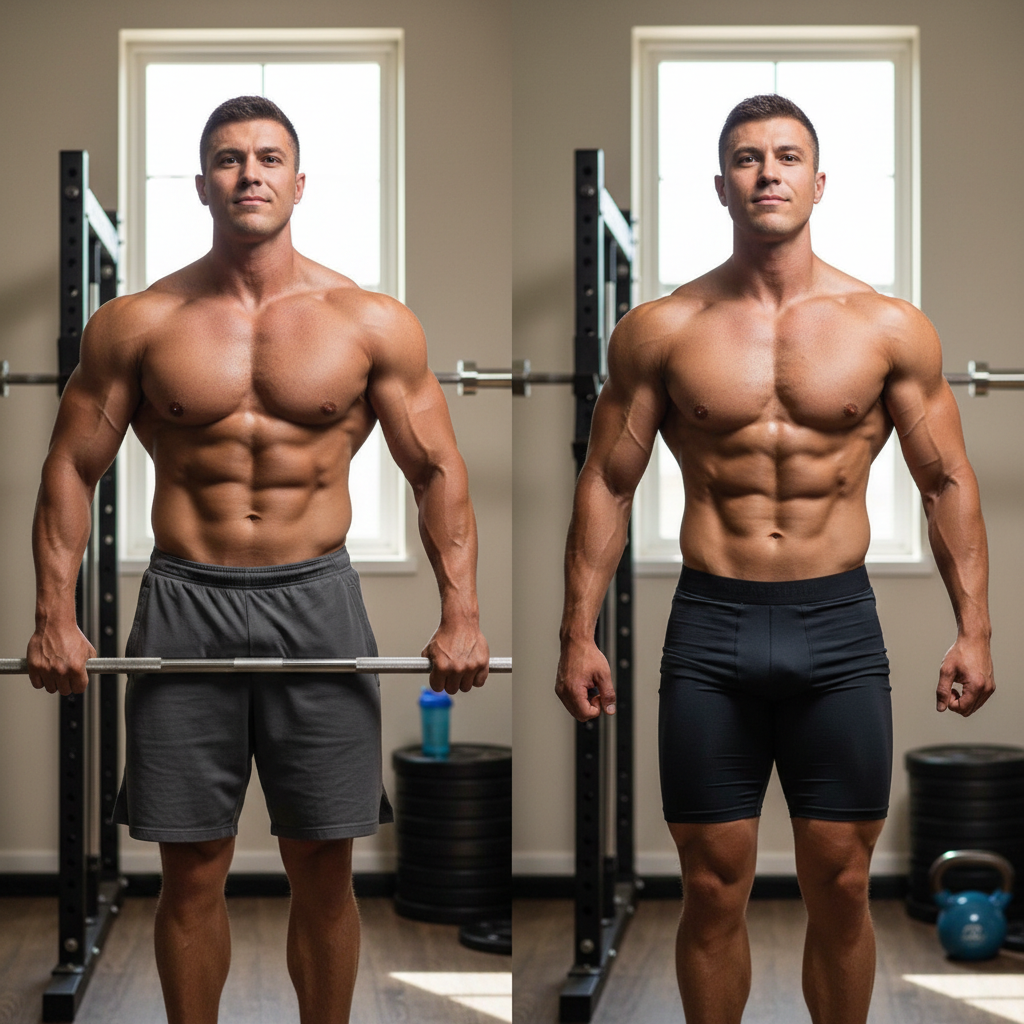
How to Modify Your Training During the Bulking to Cutting Transition
Your resistance training program should not be abandoned or dramatically overhauled when you begin a cut. The compound lifts that drove your muscle growth during the bulk, including squats, deadlifts, bench presses, barbell rows, and overhead presses, should remain the foundation of your program. These movements recruit the largest amount of muscle mass and send a clear signal to your body that the tissue it built is still being used and needs to be preserved.
What changes most significantly during the bulking to cutting transition is the addition of cardiovascular training. If you did little or no cardio during your bulk, introducing too much too quickly will spike recovery demands and potentially contribute to muscle loss. A practical starting point is two to three sessions of low-intensity steady-state cardio per week, each lasting 20 to 30 minutes. Walking, cycling at a moderate pace, or light jogging all fit this description. You can increase the duration or frequency gradually over several weeks as your body adapts.
High-intensity interval training is a useful addition to a cutting phase because it burns a substantial number of calories in a short period and tends to preserve muscle better than long, slow cardio sessions. The trade-off is that it demands more from your recovery system. If you add interval training, treat it as a supplement to your weight sessions rather than a replacement, and monitor how it affects your ability to perform in the gym. If strength and energy in your resistance sessions start to decline noticeably, scale back the cardio first.
Adjusting the rep ranges on your compound lifts is a common and sensible approach during a cut. If you were working in the three to six rep range during your bulk, shifting to eight to twelve reps with slightly reduced loads keeps the muscles under meaningful tension without placing as much stress on your joints and connective tissue. This matters because recovery capacity is reduced when calories are lower, and injuries become more likely when the body is running on less fuel.
Tracking Progress and Making Smart Adjustments
Without consistent tracking, you are essentially guessing whether your approach is working. Weighing yourself each morning under the same conditions, ideally after waking and using the bathroom, gives you the most reliable data. Because daily weight fluctuates due to water retention, food volume, and hormonal shifts, looking at weekly averages rather than individual readings will give you a much c
Weighing yourself each morning under the same conditions, ideally after waking and using the bathroom, gives you the most reliable data.
Your waist, hips, chest, and thigh measurements can tell you whether you are losing fat even on weeks when the scale does not move.
Tracking the weights and repetitions you complete each session allows you to spot trends in your strength over time.
If your weekly average weight has not changed in two consecutive weeks and you are not visibly leaner, reducing calories by another 100 to 150 per day is a reasonable next step.
Managing the Common Challenges of a Cutting Phase
Hunger is the challenge most people report most frequently during a cut, particularly in the first two to three weeks before the body begins to adjust to the lower calorie intake. High-volume, low-calorie foods are your most practical tool here. Vegetables, broth-based soups, leafy salads, and foods with high water content can fill your stomach meaningfully without adding many calories to your dai
High-volume, low-calorie foods are your most practical tool here.
One of the most effective ways to maintain training energy despite lower overall calories is to concentrate carbohydrate intake around your workouts.
When calories are restricted, the body has fewer resources available for tissue repair, immune function, and hormonal regulation.
It can feel wrong to eat less when you have spent an entire bulk conditioning yourself to eat more.

Building a Long-Term Approach to Bulking and Cutting
Neither phase of the bulking to cutting cycle should be rushed. A bulk that lasts only four or five weeks will not produce meaningful muscle gain. A cut that lasts only three weeks will not produce meaningful fat loss. Both phases need sufficient time to generate results, and the transition between them requires its own adjustment period. Treating this as a long-term process rather than a quick fix is what separates people who build lasting physique changes from those who spin their wheels year after year.
Planning your phases around a realistic timeline sets appropriate expectations from the start. Most people benefit from bulking phases that last three to six months, followed by cutting phases of comparable length depending on how much body fat was accumulated. Keeping the bulk relatively lean by avoiding excessive fat gain makes the subsequent cutting phase shorter, less demanding, and easier to sustain. A leaner bulk also means you spend less time in a deficit before reaching your target body composition.
Consistency across weeks and months matters far more than any single perfect day of eating or training. There will be days when hunger is difficult to manage, when workouts feel flat, and when the scale moves in the wrong direction. These fluctuations are normal parts of the process and should not prompt dramatic changes to your plan. Adjustments should be based on patterns observed over multiple weeks, not on how you feel on any given Tuesday morning.
The transition from bulking to cutting is not a single event but a gradual shift in strategy. By reducing calories slowly, keeping protein intake consistent, adjusting training intelligently, and using objective data to guide your decisions, you can move through this phase while preserving the muscle you built and steadily reducing body fat. The process demands patience and consistency, but the results are a direct reflection of how well you execute the fundamentals.